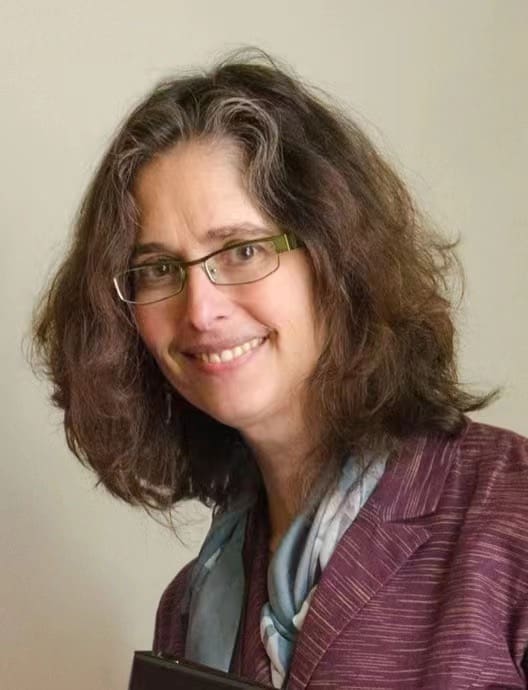
Tobie Meyer-Fong
Professor
Contact Information
- [email protected]
- Curriculum Vitae
- Gilman 330C
Research Interests: East Asia, especially social and cultural history of China since 1600
Education: PhD, Stanford University
Tobie Meyer-Fong, professor of history, is a historian of early modern and modern China. She began teaching at Johns Hopkins in 2000. She received her bachelor's degree from Yale University in 1989 and her doctoral degree from Stanford University in 1998. She served as editor of the journal Late Imperial China from 2007-2018 and recently rejoined the editorial board as an associate editor. She has been a visiting student or scholar at Nanjing University, East China Normal University, the Institute of Modern History at Academia Sinica, the Institute for Advanced Studies on Asia (Tokyo), and the Institute of Literature at the Chinese Academy of Social Sciences. Her books and several of her articles have been published in Chinese translation.
Professor Meyer-Fong is an advocate of intensive language training and promoter of regional and area expertise. She remains active as part of the second cohort of the Public Intellectuals Program organized by the National Committee on US-China Relations. She has written for the Los Angeles Review of Books, China File, China Channel, Pengpai (the Paper), and The Hill. She has appeared on the Kojo Nnamdi Show (WAMU) and been interviewed by (among others) the BBC World Service, Dongfang zaobao, Caixin Global, and the Washington Post food section.
Professor Meyer-Fong is broadly interested in the history of China, with primary expertise in the period from roughly 1600 to the present. Her research and writing emphasize the intimate and emotional effects of large-scale events at the individual and communal level. She has developed expertise in the history of the Jiangnan region, the history of publishing, taste, information, and material culture. Recent articles (in Chinese and Spanish translation) have traced the evolution of English-language scholarship about the Jiangnan region, tracked developments in the field of Qing history, and considered the history of the Taiping War at personal and global scales.
Professor Meyer-Fong has given academic and public talks focusing on the figure of Li Gui, a survivor of the Taiping civil war who circumnavigated the globe in 1876. Some of this research will be published as part of a chapter in Qing print culture in an edited volume. She also has developed projects on the state of the field of Qing studies and has offered commentary based on her research on images of the Qing dynasty (and the Chinese past more generally) in contemporary China. Her most recent research efforts have focused on the history of the Zhoushan Archipelago during the Qing dynasty. A forthcoming article in the American Historical Review's "History Unclassified" section focuses on one family's experience of outward migration from Zhoushan to the United States during the Cold War. She continues to consider the place of "early modern China in the Late Imperial World" in dialogue with colleagues at Hopkins and beyond.
Professor Meyer-Fong maintains an eclectic portfolio of undergraduate courses. These include a broad survey of China’s early and medieval history (Neolithic to Song), an introduction to the Chinese Cultural Revolution in history and memory, and a comparative survey focused on the making of National Identity in 20th-Century China and Japan. A freshman seminar, Monuments and Memory in Asian History, uses famous sites to introduce first year students to historical methods and regional dynamics. Her upper-level seminars include Women and Modern Chinese History and Late Imperial China: History and Fantasy. She has advised senior theses for both East Asian Studies and History on topics including public dancing and public health in contemporary China, the role of Johns Hopkins Medicine in the formation of Peking Union Medical College, representations of military women in 20th century China, a case study in the politics of female suicide in early 20th century Shanghai, and the image-making activities of the empress dowager Cixi in comparative perspective.
Professor Meyer-Fong admits graduate students in early modern and modern Chinese history. She also has worked closely with PhD students in East Asian sociology, politics, and literature, and those in the history department who are interested in comparative early modern empires, material culture, print culture, or gender. Her graduate seminars include Reading Qing Documents, and topical readings and courses such as Cultural Histories of Late Imperial and Modern China.
She will review files in the current cycle but plans to be on sabbatical in AY 2026-2027.
Professor Meyer-Fong is the author of two monographs and a widely cited state-of-the field article on printing and book culture in late imperial China. She also has published articles on various topics including commemoration, travel and tourism, poetry anthologies, civil war, and gardens. A list of some of her articles appears below.
“From There to Here: Thinking with a Chinese American Family Archive,” Forthcoming 2026 American Historical Review.
“Chongguan Qingchao: Beimei Qingshi yanjiu de huigu yu fansi” “Rethinking the Qing: A View from North America”重观清朝: 北美清史研究的回顾与反思, translated by Zheng Yushuang, Qingshi yanjiu 清史研究 2025 (2): 168–80. (for an English-language translation, see Chinese Historical Review, vol. 35, pp. 237-252).
“Zai Ming Qing shi zhong xunzhao Jiangnan: zuijin 30 nian Yingwen shijie de yanjiu jinzhan 在明清史中尋找江南:最近30年英文世界的研究進展 (Searching for Jiangnan in Recent Anglophone Scholarship on Ming-Qing China),” Zhao Gang, trans. Jiangnan shehui lishi pinglun 江南社會歷史評論 1 (2022): 347-370.
"Fantasy and the Forbidden City: China's most popular costume drama tells more about the present than it does about the Qing dynasty," The China Channel, 2/4/2020.
“To Know the Enemy: The Zei qing huizuan, Military Intelligence, and the Taiping Civil War,” T’oung-pao, 104 (2018) 384-423.
“Where the War Ended: Violence, Community, and Commemoration in China’s 19th Century Civil War,” American Historical Review. 120: 5 (December 2015) pp. 1724-1738.
“Civil War, Revolutionary Heritage, and The Chinese Garden,” Cross-Currents: East Asian History and Culture Review, E-Journal #13 (December 2014) http://cross-currents.berkeley.edu/e-journal/issue-13, pp. 75-98.
“Urban Space and Civil War, Hefei 1853-4,” Frontiers of History in China, 8:4 (December 2013): 469–492.
“The Printed World: Books, Publishing Culture, and Society in Late Imperial China,” Journal of Asian Studies 66:3 (Aug. 2007), pp. 787-817.

Building Culture in Early Qing Yangzhou (new Translation)
- author
- Shanghai Far East, 2025
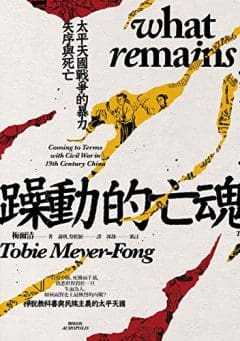
What Remains (Traditional Chinese Edition)
- author
- 衛城出版, 2020
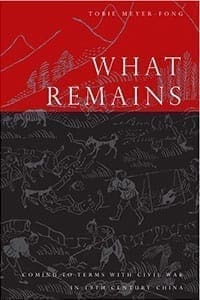
What Remains: Coming to Terms with Civil War in 19th Century China
- author
- Stanford University Press, 2013
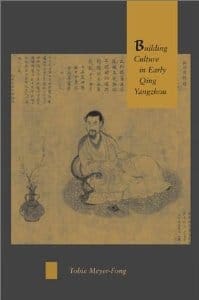
Building Culture in Early Qing Yangzhou
- author
- Stanford University Press, 2003
- “Competing Visions of China’s Distant Past,” LA Review of Books, May 28, 2026.
- “From Qing Imperial Collection to Chinese National Treasures: On Adam Brookes’ “Fragile Cargo”,” LA Review of Books, May 15, 2023.
- “Remembering in Taipei and Forgetting in Fuzhou: On Zhuqing Li’s “Daughters of the Flower Fragrant Garden: Two Sisters Separated by China’s Civil War,” LA Review of Books, August 13, 2022.
- Interviewed for BBC Documentary, “The World According to Search”
- 蓄发,黥面,伪装:太平天国的身份标志与认同 (Hair, Tattooing, and Costume: Status Signifiers and Identity in the Taiping Heavenly Kingdom),” The Paper/Pengpai sijia lishi, March 16, 2021.
- “Fantasy and the Forbidden City: China’s most popular costume drama tells more about the present than it does about the Qing dynasty,” The China Channel, 2/04/2020
- “America must invest in knowledge infrastructure to address global challenges,” The Hill, 1/29/2020,
- China File conversation, “How Does China’s Imperial Past Affect its Foreign Policy Today,” March 2017.